BABYMONSTER Performance Video: LiDAR & Matchmove Solution
Maximizing efficiency in large-scale productions with 75mm Studio's 3D scanning technology.
BABYMONSTER Performance Video: 75mm Studio's Tech Solution
In the recently released BABYMONSTER performance video, 75mm Studio handled LiDAR 3D scanning and matchmove technology, maximizing production efficiency.
As production scale expands and the number of shots increases, securing data consistency and managing post-production processes become core challenges.
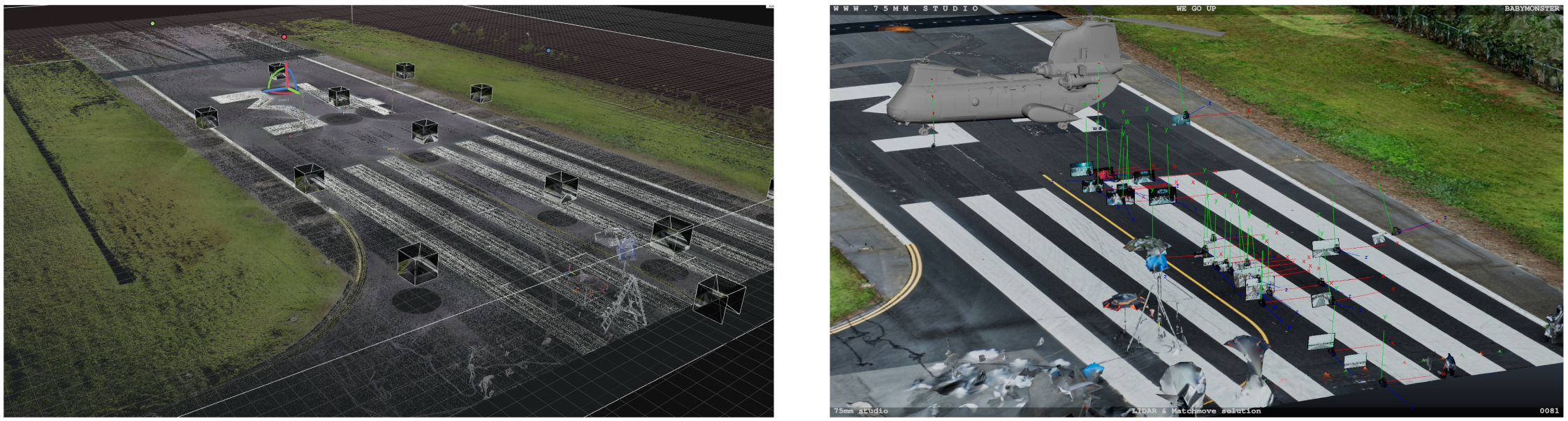 Left: LiDAR Scanning Station / Right: Camera alignment of all cuts based on scan data
01. Perfect Scene Consistency Across Multiple Shots
Large-scale projects often involve tens or hundreds of shots. Managing them individually significantly increases the risk of data inconsistency during post-production.
💡 Solution: Precise 3D Spatial Data LiDAR scanning implements every element of the shooting site into precise 3D data, enabling integrated management of all shots based on consistent digital spatial data.
This ensures visual consistency for the entire scene and fundamentally prevents potential errors in each shot. Consequently, correction and supplementation processes in post-production can be minimized.
02. Eliminating Bottlenecks and Realizing Pre-work
The biggest difficulty in existing VFX processes was 'waiting'. VFX and layout teams often had to wait until matchmove data was ready. However, 75mm Studio's solution is different.

High-precision environmental scan data secured through LiDAR functions as a 'Master Reference' for all teams immediately after shooting. This allows related teams to start work immediately without waiting for matchmove data, dramatically reducing overall production time.
03. Optimal Solution for Time and Cost Reduction
The value of LiDAR scanning becomes clearer in projects that require managing complex sites and numerous shots. 75mm Studio designs not just technical support but the efficiency of the entire pipeline. Experience overwhelming post-production efficiency and process innovation.
04. Interactive 3D Scene
You can directly check the data scanned on site.
75mm Studio goes beyond simple technical support to design the efficiency of the entire pipeline. Experience overwhelming post-production efficiency and process innovation.
Technical Details & FAQ
What is LiDAR scanning and how is it used in VFX?
How does 75mm Studio process massive Point Cloud data?
What is the primary difference between Photogrammetry and LiDAR?
Why is 3D Gaussian Splatting revolutionary for spatial archiving?
Interested in this technology? Contact Us