&TEAM 'Back to Life' Official MV: Utilizing High-Quality Texture LiDAR Scanning
Maximizing Production Efficiency with Data-Based Workflow from Pre-vis to Art Department Collaboration
Hello, this is 75mm Studio.
Did you all enjoy the recently released &TEAM's 'Back to Life' official music video? Since the on-set location was confirmed early and there was sufficient preparation time before the actual shoot, more sophisticated technical attempts were possible for this project.
When faced with numerous variables in the production stage, how can technology help creation?
Today, beyond simple field recording, we would like to introduce our LiDAR scanning solution and data-based workflow that maximized production efficiency from pre-production.
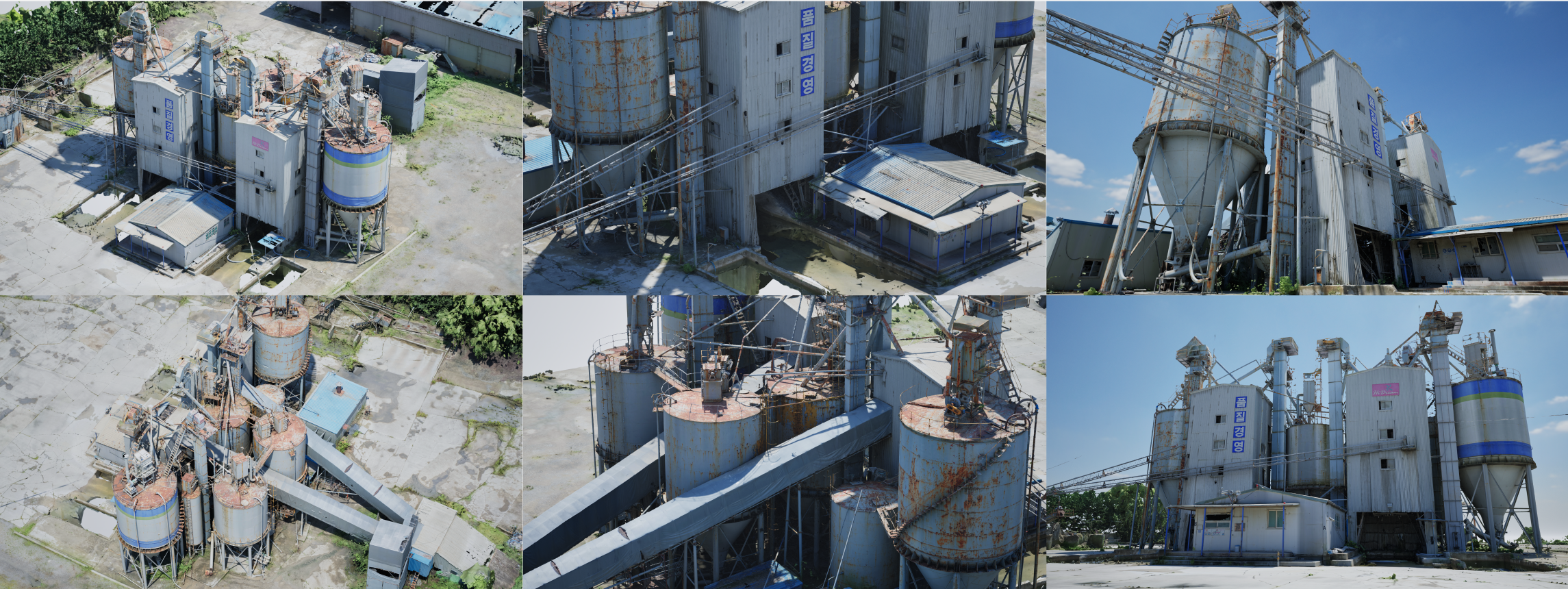
1. Pre-visualization: Turning Prediction into Certainty
Just because the location is decided doesn't mean all preparations are done. There are always unexpected variables at the actual site.
75mm Studio proposes the possibility of implementing perfect Pre-vis and Tech-vis by immediately transplanting precise scan data of the site into a digital environment. Beyond simply viewing the space in 3D, we simulate all physical and technical constraints that may occur during actual shooting.
"Not vague predictions, but certainty based on data."
Before shooting, we were able to establish a perfect shooting plan by simulating all camera angles and movements.
2. Precise Sunlight Simulation Based on Georeferencing
The most difficult light to control in outdoor shooting is the 'Sun'. The data we provide is not just a simple 3D model, but precisely Georeferences the captured data with the Geographic Coordinate System and True North.
Through this, it is possible to accurately calculate the Altitude and Azimuth of the sun according to the specific time of the actual scheduled shooting date in real-time engines like Twinmotion.
- How far the shadow casts at 10 AM on the day of shooting
- How the light at 4 PM falls on the actor's face
By perfectly predicting the position and shape of shadows that change by the minute, the lighting team and shooting team can drastically reduce trial and error on site and accurately implement the planned Look.
3. Data-Based Art Department Workflow
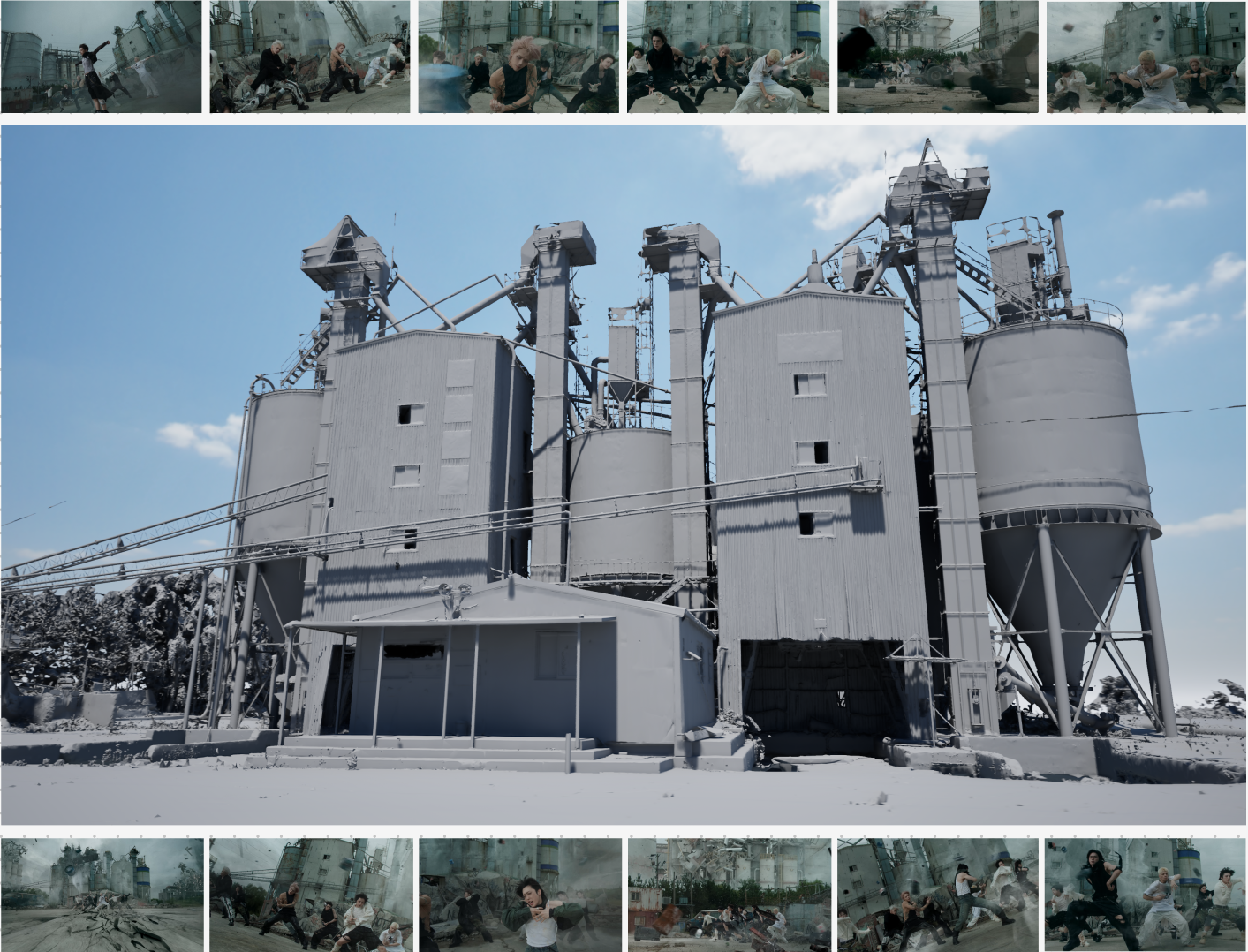
The working method of the Art Department also changes innovatively. We no longer prepare sets based on guesses relying on tape measures or visual estimation.
Based on accurate measurement data of the site, all art elements such as set dressing and prop placement are precisely layered digitally. This plays a decisive role in reducing errors that may occur during actual installation and allowing limited resources to be invested in the most efficient places.
&TEAM 'Back to Life' Official MV Set Location
This is the 3D Gaussian Splatting data of the concrete factory location used in the official music video for &TEAM's 'Back to Life'.
Technical Details & FAQ
What is LiDAR scanning and how is it used in VFX?
How does 75mm Studio process massive Point Cloud data?
What is the primary difference between Photogrammetry and LiDAR?
Why is 3D Gaussian Splatting revolutionary for spatial archiving?
Interested in this technology? Contact Us